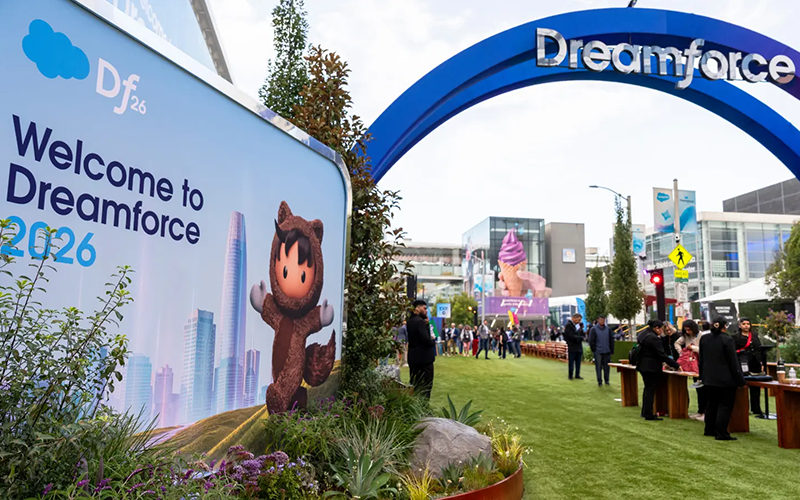
Dreamforce 2026 Round Up
The ThirdEye team returned from Dreamforce with a shared view that it's an exciting period ahead for the Salesforce ecosystem
The ThirdEye team returned from Dreamforce with a shared view that it's an exciting period ahead for the Salesforce ecosystem
Salesforce is running a multi-prong AI strategy, and once you see the shape of it the whole Dreamforce 2026 announcement list makes sense. The ThirdEye team came away from San Francisco with a clear view of where the platform is heading and what it means for our valued clients.
In short, Salesforce moved on four fronts at once, gave clients real choice at the model layer, and started moving AI out of the Salesforce interface and into the tools people already use. That is a lot of optionality arriving at the same time. And optionality is exactly what makes a good implementation partner valuable.
Every announcement from Dreamforce sits in one of four prongs. Seen together, they show a company buying, building, inventing and opening up in parallel.
Buy proven capability. Fin from Intercom and Piper from Qualified join the platform as mature products with real deployment track records behind them.
Build natively on what clients already run. Casey, Carter and Marshall land directly on the platforms clients already own, so they are fast to stand up.
Open new ground. Hunter is a long-horizon outbound runtime, a capability that simply did not exist on the platform before.
Open the platform up. This is the prong with the longest reach. AIforce exposes Salesforce data, business logic, permissions and actions to outside AI tools, and every request still respects the permissions a client already has in place.
Claudeforce sits inside that fourth prong and has two distinct areas. The first is Salesforce in Claude, which gives end users 37 prebuilt sales skills. The second is the MCP tooling and Claude Code plugin aimed at developers and admins. When a client asks us about Claudeforce, we make sure we are clear with what they need or could adopt as the conversations are very different.
A number of agents were announced with one voice and one framing, as job-ready teammates. Underneath, they are nothing like each other. This matters more than anything else for how we advise clients, because the marketing little clues into the differences in maturity or origin.
A buyer comparing Casey to Fin would reasonably assume the two are equally mature. They are not. One is a proven platform with its own model, whilst the other is a persona wrapper on top of an existing product.
The persona is not the platform
This is the comparison that matters most commercially. Casey offers fast time to value with minimal setup. You drag in files, point it at web content and go, which makes it the right fit for standard support.
Underneath Casey sits Agentforce for Service, formerly Einstein Service Agent, which is fully configurable through Agent Builder. The moment a client has complex entitlements, SLAs or custom routing, they are back in Agent Builder. That is exactly where ThirdEye's delivery work lives. The persona layer does not remove the implementation work, it just hides it until scoping.
Getting the SDR story right
Much of the coverage has muddled the sales development agents too. The 2024 Agentforce SDR Agent was inbound-only and handled one session at a time. Piper is the closest match for that inbound job, although it is not a perfect like-for-like replacement.
Hunter is different territory. It works outbound, over weeks, and keeps pursuing a goal over time, so it was never a replacement for anything. It is a new capability that can sit alongside the SDR Agent or Piper. Our advice is to judge Hunter against the gap it fills, not against what a client already has.
Underneath all four prongs sits a model layer that gives clients a real choice. Koa handles high-volume CRM work, while Claude and GPT are available through the gateway for reasoning that needs more judgement.
Koa gets the least attention of anything announced, yet it may matter most commercially. It is a CRM-tuned model built with NVIDIA on the open Nemotron base. Salesforce trained it on its own synthetic CRM data and 27 years of deployment knowledge, with no customer data involved.
On Salesforce's CRM Bench, Koa scores 0.86, effectively level with Claude Opus 4.8 at 0.87 and close behind GPT-5.5 at 0.90.
That is frontier-class performance on the CRM actions it was built for, from a much smaller model. Salesforce also reports three times fewer errors on CRM actions in its own evaluation.
The commercial point is simple. A smaller, purpose-built model should cost meaningfully less per task. The gateway routes routine work such as record updates, summarisation and case triage to Koa, and keeps the judgement-heavy reasoning with Claude or GPT.
Token spend is an operating cost, so for the large share of client workloads that do not need deep reasoning, this is a real lever.
The biggest shift for the business is that AI is moving out of the Salesforce interface and into Slack, into Claude and into the gateway.
Slackforce Surfaces gain live-data refresh from October 2026, and AIforce opens data, logic and permissions to outside tools. That is an exciting expansion of where work can happen. It also means validation, approval and audit have to travel with the work, because every new surface is a new place a regulator can ask how a decision was made.
This is where ThirdEye earns its place. Salesforce ships extraordinary capability, and clients need a partner who designs the human-in-the-loop, the audit trail and the data-residency model into the rollout from day one. Built in from the start, governance helps clients adopt faster and is the work that gets these deployments live and keeps them live.
One of the best parts of the week was seeing three ThirdEye clients present their own work and experiences to the Dreamforce audience.
AIIC is the legal group leading the way in digital transformation. Their story shows what is possible when a legal firm commits properly to Salesforce and AI.
Siemens, owner of Dotmatics, represented our technology client base and the scale of ambition we see with them and across that sector.
Fresenius Kabi, our hybrid Life Sciences and Health provider and manufacturer, is pushing the boundaries with Salesforce tooling and adoption.
Each of them is at a different stage and working in a different industry, but they share a willingness to move early and do it properly, with governance underpinning their technology. It was brilliant to see that recognised on one of the biggest stages in the industry.
The front-office agents get the headlines, but Agentforce Operations is the tool we think will quietly do some outstanding work in the period ahead. Every organisation we work with has back-office processes that live in documents, spreadsheets and people's heads, and they are slow because a person has to push each step along. Agentforce Operations takes those written processes and process maps and turns them into clear, multi-step tasks that agents can actually carry out, with people brought in only when a decision needs them.
This is the part that matters. It closes the gap between knowing what needs doing and doing it, and that gap is where most operational time is lost. Salesforce reports cycle times down by 50 to 70% and manual data entry down by 80%, so a boost in both these areas would be extremely beneficial.
Our view is simple. If your operations team still spends its week chasing tasks between systems, this is where we would start.
Dreamforce 2026 gave Salesforce customers more choice than they have ever had. There are bought, built and brand-new agents, a platform that opens up to outside AI tools, and a growing model layer that lets each task run on the right engine.
That choice is good news, but it needs careful handling. The questions we expect clients to bring to us over the coming months are practical ones:
Which agents fit the platforms we already have?
Which workloads can move to Koa, and what will that save?
How should we be using Claudeforce, and which functionality is best for us?
How do we keep oversight, audit and data residency intact as work moves into Slack and Claude?
These are the conversations ThirdEye is ready to have. If you would like to talk through what Dreamforce means for your own roadmap, get in touch with the team.
Get in touch and tell us about your project or challenge